How to Choose the Right Mixed Flow Fan for Industrial Ventilation
Choosing the right mixed flow fan is essential for achieving efficient and reliable industrial ventilation. In factories, warehouses, commercial buildings, underground garages, and industrial facilities, ventilation systems must provide sufficient airflow while overcoming resistance from ducts, filters, dampers, and other components. Compared with conventional axial fans and centrifugal fans, a mixed flow fan combines the characteristics of both designs, offering a balance between airflow volume and static pressure.
However, selecting an industrial mixed flow fan involves more than checking motor power or fan dimensions. Buyers and engineers need to consider airflow requirements, static pressure, duct configuration, operating environment, energy efficiency, and installation conditions. Choosing the wrong equipment may result in insufficient ventilation, excessive energy consumption, and unstable system performance. This guide explains how to select the right mixed flow fan for industrial ventilation and what international buyers should consider before purchasing.

What Is a Mixed Flow Fan and How Does It Work?
A mixed flow fan is an air-moving device that combines the aerodynamic characteristics of axial and centrifugal fans. During operation, air enters the fan along the shaft direction and passes through a specially designed impeller. The airflow is then discharged in a direction that combines axial and radial components, allowing the fan to provide a balance between airflow capacity and pressure performance.
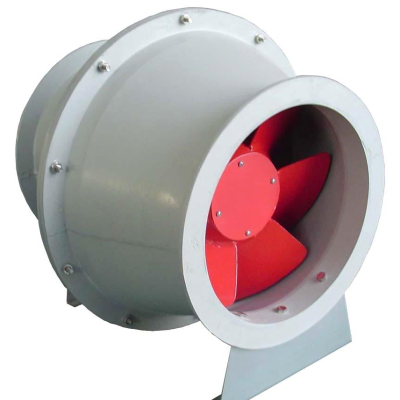
The main components of an industrial mixed flow fan generally include an impeller, casing, inlet collector, guide vanes, and motor. The impeller is responsible for generating airflow, while the casing and guide vanes help guide the air and maintain stable flow distribution. Different blade structures and fan configurations influence the final airflow, pressure, efficiency, and noise characteristics.
Shunda's high efficiency mixed flow industrial air blower uses twisted impeller blades and guide vanes to improve aerodynamic performance and airflow distribution. Its design combines relatively higher pressure capability than conventional axial fans with larger airflow capacity than many centrifugal fan configurations. This makes it a practical option for ventilation applications that require a balance between airflow and pressure.
Why Choose a Mixed Flow Fan for Industrial Ventilation?
One of the main reasons to choose a mixed flow fan is its balanced aerodynamic performance. In many industrial ventilation projects, the system requires more pressure than a basic axial fan can conveniently provide, but does not necessarily require the high-pressure characteristics of a conventional centrifugal fan. A mixed flow fan can help meet these intermediate operating requirements.
For example, a factory ventilation system may include several sections of ductwork, multiple bends, air outlets, and dampers. These components create resistance that the fan must overcome to maintain the required airflow. In such applications, a mixed flow fan can provide a suitable combination of air volume and pressure, depending on its model and operating point.
Energy efficiency is another important consideration. A correctly selected fan can reduce unnecessary power consumption by operating closer to its appropriate performance range. Compact construction can also provide installation advantages in mechanical rooms, ceiling spaces, and ducted ventilation systems where available space is limited.
In addition, mixed flow fans can be used in different ventilation and air exchange applications. Depending on the product configuration, they may be suitable for factories, underground garages, tunnels, high-rise buildings, and other industrial or commercial facilities.
Key Factors to Consider When Selecting an Industrial Mixed Flow Fan
1. Determine the Required Airflow Volume
Airflow volume is one of the first parameters to determine when selecting an industrial mixed flow fan. It refers to the amount of air that a fan can move within a specific period and is commonly measured in cubic meters per hour (m³/h) or cubic feet per minute (CFM).
For general room ventilation, a preliminary airflow estimate can be calculated using the room volume and required air changes per hour:
Required Airflow = Room Volume × Air Changes per Hour
For example, if a workshop has a volume of 3,000 m³ and requires 6 air changes per hour, the preliminary ventilation airflow requirement is:
3,000 × 6 = 18,000 m³/h.
This calculation provides an initial reference for general ventilation design. However, actual airflow requirements may be higher or lower depending on production processes, equipment heat generation, the number of workers, pollutant emissions, and local ventilation standards.
For industrial exhaust applications involving dust, fumes, or chemical substances, engineers should also evaluate local exhaust requirements and pollutant capture performance. Simply increasing the general air exchange rate may not effectively remove contaminants at their source.
Before purchasing a mixed flow fan, buyers should clearly identify the required airflow under actual operating conditions rather than relying only on the maximum airflow stated in a product catalog.
2. Calculate Static Pressure and System Resistance
Static pressure is another essential parameter in mixed flow fan selection. It represents the pressure required to overcome resistance within the ventilation system and maintain the designed airflow.
In industrial duct systems, resistance is generated by straight ducts, elbows, reducers, filters, dampers, silencers, grilles, and exhaust outlets. As the duct network becomes longer or more complicated, the total pressure loss generally increases.
If the selected fan cannot provide sufficient pressure, its actual airflow may be significantly lower than expected. This can lead to poor air exchange, insufficient exhaust performance, and unstable ventilation.
Engineers should calculate the total system pressure loss and compare it with the fan performance curve. The selected mixed flow fan must deliver the required airflow at the actual operating static pressure.
This is particularly important for long-distance duct ventilation, underground garages, tunnels, and industrial facilities with multiple ventilation branches.
3. Evaluate the Operating Environment and Material Requirements
Different industrial environments create different demands on ventilation equipment. A standard manufacturing workshop may only require general air circulation, while a chemical plant or wastewater treatment facility may involve corrosive gases, high humidity, dust, or other challenging operating conditions.
When selecting a mixed flow fan for these environments, buyers should consider the materials used for the casing, impeller, motor protection, and other components. Corrosive environments may require suitable corrosion-resistant materials and protective treatments. Dust-laden air may require additional consideration of impeller design, cleaning access, and maintenance frequency.
For locations where flammable gases or combustible dust may be present, an explosion-proof fan may be required. Buyers should identify the hazardous area classification and verify the applicable certification and compliance documentation for the complete fan and motor configuration before purchasing.
Shunda provides different mixed flow fan configurations for industrial applications, including the High Efficiency Mixed Flow Industrial Air Blower and Explosion Proof Mixed Flow Fan. The appropriate model should be confirmed according to the actual working environment and project requirements.
4. Consider Motor Power and Energy Efficiency
Motor power is an important specification, but it should not be the only basis for selecting a mixed flow fan. A fan with a larger motor does not automatically deliver better ventilation performance or lower operating costs.
The actual operating point should be evaluated by considering airflow, static pressure, fan speed, motor power, and aerodynamic efficiency. The fan should be capable of delivering the required performance without unnecessary energy consumption or motor overload.
For industrial facilities where ventilation equipment operates for long periods, energy efficiency can have a significant impact on total operating costs. Correct fan sizing, appropriate motor selection, suitable control methods, and regular maintenance all contribute to reliable operation.
If ventilation demand changes during different production periods, a compatible variable speed control system may help adjust fan output according to actual requirements. However, the motor, electrical configuration, and fan operating range should be checked before applying speed control.
Buyers should also confirm the local power supply requirements, including voltage, frequency, and single-phase or three-phase electrical connections.
5. Check Installation Space, Duct Dimensions, and Noise Levels
Installation conditions should be evaluated before finalizing a mixed flow fan model. Available space, duct diameter, connection dimensions, airflow direction, and maintenance access can all influence equipment selection.
For inline ventilation systems, the fan should be matched with the duct dimensions and installation arrangement. Poor duct transitions, sharp bends, and insufficient straight sections may increase turbulence and pressure loss, affecting the actual operating performance.
Noise is another important consideration, particularly in commercial buildings, workshops, and facilities with occupied working areas. Fan speed, impeller balance, airflow turbulence, vibration, and installation quality can all influence operating noise.
Where necessary, engineers can consider vibration isolation, flexible connectors, acoustic insulation, and suitable silencers. These measures can help improve the overall ventilation system and create a more comfortable working environment.
Mixed Flow Fan vs. Axial Fan vs. Centrifugal Fan: Which One Should You Choose?
Choosing between a mixed flow fan, axial fan, and centrifugal fan depends on the actual ventilation requirements. Although all three types are used in industrial and HVAC applications, their airflow characteristics and pressure capabilities are different.
An axial flow fan moves air mainly parallel to the motor shaft. It is generally suitable for applications requiring large airflow with relatively low system resistance, such as factory ventilation, warehouse air circulation, and equipment cooling. For projects with relatively simple ventilation paths, axial fans can provide an economical and practical solution. You can explore Shunda's Industrial Axial Flow Fan Products for different ventilation applications.
A centrifugal fan draws air into the impeller and discharges it in a direction that is generally perpendicular to the inlet airflow. It is commonly used in applications requiring higher static pressure, such as dust collection, industrial exhaust, filtration systems, and complex duct networks. For projects involving considerable system resistance, an industrial centrifugal fan may be a more suitable option. Shunda provides a range of Industrial Centrifugal Fans for different industrial requirements.
A mixed flow fan combines the characteristics of both designs. It is often suitable for ventilation systems requiring a balance between airflow volume and pressure performance, especially where duct resistance and installation space need to be considered together.
Therefore, no single fan type is suitable for every project. Engineers should compare the required airflow, system resistance, fan performance curves, installation conditions, and total operating costs before making a final decision.
Common Industrial Applications of Mixed Flow Fans
Mixed flow fans are used in a variety of industrial and commercial ventilation systems because of their balanced airflow and pressure characteristics.
In manufacturing facilities, they can support general ventilation, heat removal, and indoor air exchange. Production equipment may generate considerable heat, while certain manufacturing processes may require continuous air circulation to maintain suitable indoor conditions. An appropriately selected industrial mixed flow fan can help improve air movement and support the overall ventilation system.
In underground garages and tunnel ventilation projects, mixed flow fans can be used for air exchange and exhaust applications. These environments often involve long duct systems, limited installation space, and specific pressure requirements. Fan selection should therefore consider the actual duct configuration, ventilation capacity, and applicable fire and life-safety requirements.
In commercial buildings and high-rise structures, mixed flow fans can be integrated into HVAC ventilation systems to support fresh air supply and exhaust air movement. Their compact construction can be advantageous where equipment space is limited.
They may also be considered for certain applications in metallurgy, factories, and mines. However, when air contains heavy dust, abrasive particles, corrosive substances, or potentially explosive materials, the fan construction and protection configuration must be evaluated carefully before selection.
Why Choose Shunda HVAC for Mixed Flow Fan Solutions?
Selecting the right ventilation equipment requires more than comparing product specifications. Buyers also need a manufacturer that can provide technical information, product customization, and support throughout the purchasing and installation process.
Shunda Air Conditioning Equipment Group Co., Ltd. was established in 2005 and specializes in HVAC, industrial ventilation, and smoke exhaust equipment. The company has a manufacturing facility covering more than 70,000 m² and a product range that includes industrial fans, air handling equipment, ventilation systems, and related HVAC products.
Shunda's mixed flow fan range includes high-efficiency and explosion-proof configurations designed for different project requirements. Depending on the application, customers can discuss airflow volume, static pressure, motor power, installation dimensions, materials, and operating conditions with the technical team.
Shunda also provides technical consultation, product catalogs, performance parameter tables, installation drawings, and operating instructions. Customized products and implementation plans can be discussed according to customer drawings and actual working conditions.
Whether you are an industrial ventilation contractor, HVAC distributor, engineering company, or factory owner, Shunda can help you evaluate suitable mixed flow fan solutions for your project.
Conclusion: Choose a Mixed Flow Fan Based on Actual Operating Conditions
Selecting the right mixed flow fan for industrial ventilation requires a comprehensive evaluation of airflow volume, static pressure, system resistance, motor performance, installation space, noise requirements, and operating environment.
A fan that appears suitable in a product catalog may not deliver the expected results if it is not matched with the actual ventilation system. Before purchasing, confirm the required airflow and pressure, review the fan performance curve, and communicate the installation and environmental requirements with your supplier.
By selecting equipment according to real operating conditions, businesses can improve ventilation reliability, reduce unnecessary energy consumption, and achieve more stable long-term performance.
Looking for a reliable mixed flow fan manufacturer for your industrial ventilation project?
Contact Shunda HVAC to discuss your requirements and request a suitable product recommendation. Send us your required airflow, static pressure, duct dimensions, operating environment, and power supply information. Our team can help you evaluate suitable mixed flow fan options and provide a quotation based on your project needs.
Website: https://www.shundahvac.com/
Email: silvia@shundahvac.com