What Are the Types of Industrial Fans? A Complete Guide to Industrial Fan Applications
Industrial fans play an essential role in modern manufacturing, commercial buildings, HVAC systems, and industrial ventilation projects. From removing hot air in factories to exhausting dust and fumes from production lines, the right industrial ventilation fan helps maintain air quality, improve working conditions, protect equipment, and support efficient industrial operations. However, with so many industrial fan types available on the market, choosing the right equipment can be challenging for buyers, engineers, and project contractors.
So, what are the types of industrial fans, and how do they differ in terms of airflow, pressure, structure, and application? Generally, industrial fans can be classified into several main categories according to their airflow direction and impeller design, including centrifugal fans, axial flow fans, mixed flow fans, and cross flow fans. Different industrial fan designs are suitable for different ventilation requirements. Understanding their characteristics is the first step toward selecting a reliable and energy-efficient industrial ventilation solution.
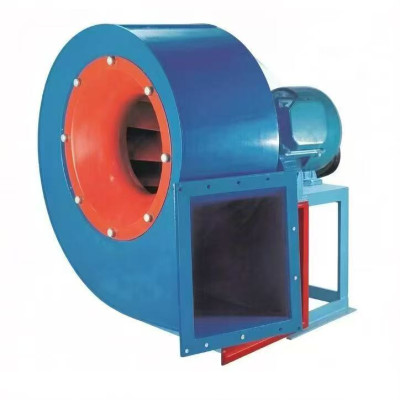
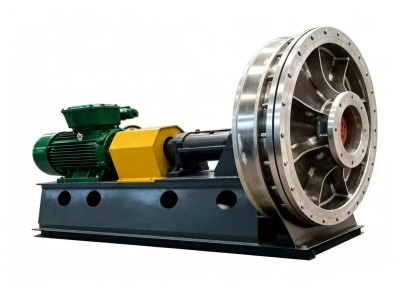
1. Centrifugal Fans: High-Pressure Industrial Airflow Solutions
A centrifugal fan is one of the most widely used types of industrial fans, especially in applications that require relatively high static pressure and stable airflow through ductwork. Unlike axial fans, which move air parallel to the motor shaft, centrifugal fans draw air into the center of the impeller and discharge it outward in a radial direction. The rotating impeller converts mechanical energy into airflow and pressure, allowing the fan to overcome resistance from ducts, filters, ventilation equipment, and industrial processing systems.
Industrial centrifugal fans are commonly used in factory ventilation, dust collection, fume extraction, boiler systems, chemical processing plants, and industrial exhaust systems. They are particularly suitable for applications where air needs to travel through long duct networks or pass through equipment with significant airflow resistance. Depending on the impeller design, centrifugal fans can be further divided into forward-curved, backward-curved, and radial-blade centrifugal fans. Backward-curved centrifugal fans are often selected for efficient air movement in suitable operating conditions, while radial-blade designs are useful in certain applications involving dust or particulate-laden air. The final selection should always consider the characteristics of the conveyed material and the fan's operating conditions.
For manufacturers and industrial buyers looking for a dependable centrifugal fan, important considerations include airflow capacity, static pressure, impeller material, motor power, operating temperature, and corrosion resistance. Shunda provides industrial centrifugal fan solutions for different ventilation and air-handling requirements, with options that can be evaluated according to specific project conditions.
2. Axial Flow Fans: High-Volume Airflow for Industrial Ventilation
Axial flow fans are another major category of industrial fans and are widely used in factories, warehouses, workshops, tunnels, and commercial HVAC systems. An axial fan moves air in a direction parallel to its rotating shaft. Its propeller-style impeller pushes air directly through the fan, making it suitable for applications that require large airflow volumes and relatively low system resistance.
Compared with centrifugal fans, industrial axial fans generally have a more straightforward airflow path and compact installation structure. They are commonly installed on factory walls, ventilation ducts, ceilings, and industrial equipment to provide fresh air, remove hot air, and improve air circulation. Typical applications include warehouse ventilation, workshop cooling, equipment ventilation, tunnel ventilation, and general industrial exhaust.
Industrial axial fans include propeller fans, tube axial fans, and vane axial fans. Propeller fans are commonly used for direct ventilation through walls or openings, while tube axial fans are installed inside cylindrical housings and are suitable for ducted ventilation. Vane axial fans incorporate guide vanes to improve airflow characteristics and pressure performance under suitable operating conditions.
For industries involving moisture, chemicals, or corrosive gases, material selection is particularly important. FRP (fiberglass reinforced plastic) axial fans offer corrosion-resistant properties and can be considered for suitable applications in chemical plants, wastewater treatment facilities, laboratories, and other environments where corrosion protection is required. Shunda's industrial axial fan range includes solutions for different industrial ventilation requirements, including FRP fan options.
3. Mixed Flow Fans: A Combination of Axial and Centrifugal Designs
Mixed flow fans combine characteristics of axial and centrifugal airflow designs. Air enters the fan generally along the shaft axis and leaves at an angle between the axial and radial directions. This structure allows mixed flow fans to provide a balance between airflow volume and pressure performance, making them suitable for ventilation systems that require more pressure than a typical propeller fan but do not necessarily need a conventional centrifugal fan.
Industrial mixed flow fans are often used in inline ventilation systems, commercial HVAC installations, ducted air supply, and industrial exhaust applications. Their compact structure can make them convenient for installations where available space is limited. Depending on the system design, mixed flow fans can provide a practical solution for moving air through ductwork while maintaining a relatively compact equipment footprint.
When choosing a mixed flow fan, engineers should evaluate the required airflow, static pressure, duct resistance, noise requirements, and installation space. It is also important to compare the actual fan performance curve with the system operating point rather than selecting equipment based only on its rated airflow.
4. Cross Flow Fans: Uniform Air Distribution for Specialized Applications
Cross flow fans, also known as tangential fans, use a long cylindrical impeller to generate airflow across the width of the fan. Unlike conventional axial and centrifugal fans, air passes through the impeller in a cross-flow pattern, allowing the fan to deliver a relatively wide and uniform air stream.
Cross flow fans are commonly found in air curtains, air-conditioning equipment, electronic cooling systems, and certain specialized ventilation applications. Their long airflow distribution makes them useful where a broad and relatively even air stream is needed. However, they are generally not the first choice for heavy-duty industrial ventilation systems that require high static pressure or the movement of large volumes of contaminated air through extensive duct networks.
For industrial buyers, cross flow fans should be considered according to their specific equipment design and airflow distribution requirements rather than treated as a universal replacement for axial or centrifugal fans.
5. Industrial Roof Exhaust Fans: Effective Heat and Stale Air Removal
Industrial roof exhaust fans are designed to remove hot air, humidity, and stale air from buildings through roof-mounted ventilation systems. They are commonly installed in factories, warehouses, workshops, and large industrial facilities where heat accumulates during production processes.
Depending on their construction, roof exhaust fans can use axial or centrifugal impellers. Axial roof fans are generally suitable for high-volume ventilation with relatively low resistance, while centrifugal roof exhaust fans can be considered when the system requires different pressure characteristics or specific duct arrangements.
In regions with high temperatures, such as Southeast Asia and the Middle East, effective industrial roof ventilation can help remove accumulated heat and improve indoor working conditions. For facilities in Saudi Arabia, Malaysia, Singapore, the Philippines, and other hot-climate markets, roof ventilation should be designed according to building structure, outdoor conditions, internal heat generation, and required air exchange rates.
6. Explosion-Proof and Corrosion-Resistant Industrial Fans
In addition to airflow design, industrial fans can also be classified according to their construction materials, safety requirements, and operating environments. Explosion-proof industrial fans are designed for applications where flammable gases, vapors, or combustible dust may create hazardous atmospheres. They may be required in certain chemical plants, petroleum facilities, pharmaceutical production areas, and other classified hazardous locations. However, the fan must be selected according to the applicable hazardous-area classification, certification requirements, and the complete installation design. An ordinary industrial fan should never be assumed suitable for a hazardous atmosphere simply because it has a special motor or metal housing.
Corrosion-resistant industrial fans are another important category, particularly for chemical processing, wastewater treatment, electroplating, fertilizer production, and other industrial environments involving corrosive gases or moisture. FRP centrifugal fans and FRP axial fans can provide material advantages in suitable corrosive environments. The actual resistance depends on the resin system, construction, temperature, chemical concentration, and operating conditions. Selecting the right material helps extend equipment service life and reduce maintenance requirements.
For industrial projects, the fan's construction material and safety configuration are just as important as its airflow and pressure performance. Buyers should communicate the actual working environment to the manufacturer before confirming the final model.
How to Choose the Right Type of Industrial Fan?
Understanding the different types of industrial fans is important, but selecting the correct model requires a more detailed evaluation of the ventilation system. The first consideration is the required airflow volume, usually measured in cubic meters per hour (m³/h) or cubic feet per minute (CFM). This determines how much air the fan needs to move within a specific period. The second consideration is static pressure, which represents the resistance that the fan must overcome in the ventilation system. Duct length, bends, filters, dampers, air outlets, and other components can all affect the required pressure.
For large factories and warehouses that need general air exchange, industrial axial fans are often a suitable starting point because of their high-volume airflow characteristics. For dust extraction, fume exhaust, and ducted ventilation systems with relatively high resistance, centrifugal fans are often more appropriate. When both airflow and pressure need to be balanced within a compact ducted system, mixed flow fans may also be worth evaluating. Meanwhile, corrosive environments require careful consideration of FRP or other suitable materials, and hazardous environments require properly certified equipment.
Motor power should not be the only factor when comparing industrial fan suppliers. A fan with a larger motor does not automatically provide better system performance. Buyers should compare airflow, static pressure, operating efficiency, noise level, impeller design, material, installation conditions, and long-term maintenance requirements. Providing accurate project parameters to the manufacturer helps ensure that the recommended industrial ventilation fan matches the actual application.
Why Choose Shunda for Industrial Fan Solutions?
Choosing a reliable industrial fan manufacturer is an important part of any ventilation project. Shunda HVAC focuses on air movement and ventilation equipment for industrial and commercial applications, offering product solutions that include centrifugal fans, axial flow fans, and other HVAC air-moving equipment.
Whether you are sourcing an industrial centrifugal fan for a factory exhaust system, an FRP axial fan for a corrosive environment, or a customized ventilation solution for a large industrial facility, selecting a manufacturer that understands your project requirements can make the purchasing process more efficient. Different industries have different demands for airflow, pressure, materials, motor configurations, and installation dimensions. Therefore, customized technical communication is essential before placing a bulk order or starting a new engineering project.
Shunda welcomes inquiries from overseas distributors, engineering contractors, industrial equipment buyers, and OEM partners. If you are planning an industrial ventilation project in Southeast Asia, the Middle East, Russia, or other international markets, our team can help you evaluate suitable fan solutions according to your application requirements.
Contact Shunda HVAC for an Industrial Fan Quote
Looking for a reliable industrial fan supplier or manufacturer? Tell us about your application, required airflow, static pressure, installation environment, and quantity. Our team can help you identify a suitable industrial fan solution for your project.
Contact Shunda today to request product information, technical consultation, and a factory-direct quotation. Whether you need centrifugal fans, axial flow fans, FRP industrial fans, or customized ventilation equipment, we are ready to discuss your requirements and support your next project.
Get a Quote Now and Find the Right Industrial Fan for Your Application!