What Factors Affect Air Handling Unit Selection? A Complete Guide
Air handling units (AHUs) are essential components of modern HVAC systems, providing ventilation, air filtration, heating, cooling, and humidity control for commercial and industrial buildings. However, choosing the right air handling unit is not simply a matter of selecting a model with sufficient cooling capacity. Air handling unit selection requires careful consideration of airflow requirements, cooling and heating loads, filtration efficiency, fan performance, installation conditions, energy consumption, and long-term maintenance costs.
An incorrectly selected AHU may result in insufficient airflow, unstable indoor temperatures, excessive energy consumption, poor indoor air quality, or higher operating expenses. For project owners, HVAC contractors, and engineering companies, understanding the key factors affecting AHU selection is essential to achieving reliable system performance. This guide explains what to consider before purchasing an air handling unit and how to choose a configuration that matches your actual project requirements.

1. Airflow Requirements and Building Size
Airflow capacity is one of the most important factors in air handling unit selection. An AHU must supply enough conditioned air to maintain the required indoor temperature, ventilation rate, and air distribution throughout the building. The required airflow depends on several conditions, including the building's floor area, ceiling height, occupancy, equipment heat generation, and ventilation standards.
For example, an office building, shopping mall, hospital, and industrial workshop have very different ventilation requirements. A commercial office may prioritize occupant comfort and fresh air supply, while a manufacturing facility may require higher airflow to remove process heat, dust, or other airborne contaminants. Therefore, selecting an AHU based only on building area can lead to inaccurate sizing.
Before choosing an air handling unit, engineers should calculate the required supply airflow based on the building's cooling and heating loads, fresh air requirements, and indoor air quality targets. The selected unit should provide sufficient airflow under actual operating conditions rather than only meeting its nominal capacity. Both insufficient and excessive airflow can create problems, including poor air circulation, increased fan energy consumption, and uncomfortable indoor conditions.
2. Cooling and Heating Capacity
Cooling and heating capacity directly affect whether an air handling unit can maintain the desired indoor environment. The required capacity depends on outdoor climate conditions, indoor temperature settings, building insulation, solar heat gain, occupancy, lighting, and equipment loads.
For projects in Southeast Asia and the Middle East, high outdoor temperatures and humidity levels make cooling and dehumidification particularly important. The AHU cooling coil must be selected to handle both sensible and latent heat loads. In environments with high moisture levels, an undersized cooling coil may struggle to remove sufficient humidity, even when the supply air temperature appears acceptable.
Heating requirements should also be evaluated for projects in colder regions, including Russia and other areas with significant seasonal temperature variations. Depending on the application, an AHU may require hot water heating coils, electric heating, or other heating configurations.
When selecting an AHU, buyers should provide the design entering and leaving air temperatures, chilled water supply and return temperatures, heating requirements, and expected operating conditions. These details help manufacturers calculate the appropriate coil capacity and configuration instead of relying on general model specifications.

3. Air Filtration Efficiency and Indoor Air Quality
Air filtration is another critical consideration when selecting an air handling unit. Different buildings have different air cleanliness requirements, so the filtration system should be matched to the actual application.
For ordinary commercial buildings, pre-filters are commonly used to capture larger dust particles and protect downstream components. For hospitals, pharmaceutical facilities, laboratories, electronics factories, and cleanrooms, higher filtration efficiency may be required to control airborne particles and maintain stricter indoor air quality standards.
A multi-stage filtration configuration can improve air cleanliness while extending the service life of individual filters. For example, a system may combine G4 pre-filtration with F7 or F8 medium filtration, depending on the project's requirements. More demanding applications may require additional high-efficiency filtration stages.
However, higher filtration efficiency generally increases airflow resistance. This means the fan must be selected to overcome the pressure drop across the filters while maintaining the required airflow. Filter replacement frequency, maintenance accessibility, and the availability of replacement filters should also be considered during the selection process.
4. Fan Performance and External Static Pressure
Fan performance has a direct influence on AHU operating efficiency and overall HVAC system performance. The fan must deliver the required airflow against the resistance created by ductwork, filters, cooling coils, heating coils, dampers, silencers, and other system components.
External static pressure is particularly important in ducted HVAC systems. If the selected fan cannot overcome the total system resistance, actual airflow may be lower than expected. On the other hand, selecting an unnecessarily powerful fan can increase initial investment and electricity consumption.
When comparing different air handling unit models, buyers should evaluate the fan type, motor power, operating efficiency, airflow range, and available static pressure. Variable frequency drives can also help adjust fan speed according to changing ventilation demands, improving operational flexibility and reducing unnecessary energy consumption.
Fan selection should therefore be based on the complete system resistance calculation rather than airflow capacity alone. This is especially important for large commercial buildings and industrial facilities with long duct networks or multiple air distribution sections.
5. Installation Space and AHU Structure
The physical dimensions and structural configuration of an air handling unit can significantly affect equipment selection. Before ordering an AHU, project engineers should confirm the available installation area, equipment room dimensions, ceiling height, transportation routes, lifting conditions, and maintenance clearance.
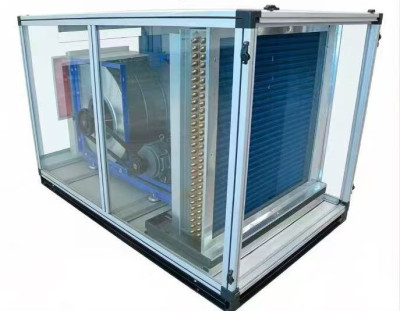
Traditional integrated units may be suitable for projects with sufficient equipment room space. However, large-capacity systems often require modular air handling units because their sectional construction allows easier transportation and on-site assembly.
A modular AHU can combine different functional sections, such as mixing, filtration, cooling, heating, humidification, and fan sections, according to project requirements. Its configuration can be adjusted to accommodate different building layouts and air treatment processes.
Panel insulation, frame strength, airtightness, corrosion resistance, and condensate drainage design are also important. For example, double-skin insulated panels can help reduce heat transfer and prevent unwanted condensation under appropriate operating conditions. A well-designed drainage system helps remove condensate from the cooling section and supports reliable long-term operation.

6. Energy Efficiency and Operating Costs
The purchase price is only one part of the total cost of an air handling unit. Since AHUs may operate for long periods every day, electricity consumption, maintenance expenses, and equipment service life should all be included in the purchasing decision.
Energy-efficient AHU selection involves evaluating fan efficiency, motor performance, cooling coil design, filter pressure drop, insulation quality, and control systems. A properly sized cooling coil and an efficient fan can reduce unnecessary energy consumption while maintaining the required indoor conditions.
Variable frequency drives, intelligent control systems, and temperature-based operating strategies can further improve energy management. For buildings with changing occupancy or ventilation demands, adjustable airflow can prevent the system from operating continuously at maximum capacity.
It is also important to compare the expected lifecycle cost rather than focusing exclusively on the initial equipment quotation. A slightly higher investment in a more efficient air handling unit may provide long-term savings through lower electricity consumption and reduced maintenance requirements.
7. Operating Environment and Application Requirements
The operating environment determines which materials, components, and protective features are appropriate for an AHU. Commercial buildings generally focus on thermal comfort, fresh air supply, and noise control, while industrial facilities may require more specialized configurations.
Factories with high humidity, corrosive gases, chemical vapors, or airborne dust may need corrosion-resistant materials, suitable protective coatings, and customized filtration arrangements. Pharmaceutical factories and food processing facilities may require more stringent air cleanliness and temperature control. Hospitals and laboratories may have additional requirements for ventilation, filtration, and room pressure management.
Climate conditions should also be considered. In tropical regions, high humidity and heavy rainfall can affect equipment operation and insulation requirements. In hot and dusty environments, such as parts of the Middle East, filter configuration and maintenance intervals become especially important.
Choosing an AHU based on its actual operating environment helps reduce premature component deterioration and supports more stable system performance.
8. Maintenance, Noise, and Supplier Support
Maintenance accessibility is often overlooked during the initial equipment selection process, but it has a significant impact on long-term operating costs. Filters, fans, motors, cooling coils, drain pans, and control components should be accessible for inspection, cleaning, and replacement.
Noise levels are another important consideration, particularly in hotels, offices, hospitals, and other buildings where acoustic comfort matters. Fan speed, airflow velocity, equipment structure, vibration isolation, and duct design can all influence operating noise.
The manufacturer's technical capabilities should also be evaluated before purchasing. A reliable AHU supplier should be able to provide detailed product specifications, performance calculations, customized configurations, installation guidance, and after-sales support. For international projects, export experience, packaging quality, technical communication, and spare parts availability are also worth considering.
Working with an experienced manufacturer helps ensure that the selected air handling unit matches the project's technical requirements rather than simply fitting within the purchasing budget.
9. Why Customized AHU Selection Matters
Standard air handling units can meet many general ventilation and air conditioning requirements. However, large industrial and commercial projects often have different airflow, cooling capacity, filtration, installation, and control requirements. In these situations, a customized AHU configuration can provide a more suitable solution.
A modular air handling unit allows different functional sections to be combined according to the project's specific needs. This makes it possible to adjust the equipment configuration, airflow capacity, coil arrangement, filtration stages, and control functions.
At Shunda HVAC, our Modular Air Handling Units are designed for a wide range of commercial and industrial applications. The product range covers airflow capacities from 3,500 m³/h to 200,000 m³/h, with customizable functional sections to accommodate different project requirements. Applications include hotels, office buildings, shopping malls, factories, pharmaceutical facilities, and cleanroom environments.
For projects requiring compact equipment and concealed installation, Shunda also provides Floor-Mounted Air Handling Units, with 13 models and 39 specifications covering airflow capacities from 1,500 to 15,000 m³/h.
By evaluating the project conditions and technical requirements before production, buyers can obtain an AHU solution that balances performance, installation convenience, energy efficiency, and long-term operating costs.
Conclusion: How to Choose the Right Air Handling Unit
Choosing the right air handling unit requires more than comparing equipment prices or nominal cooling capacities. Airflow, cooling and heating loads, filtration efficiency, fan performance, static pressure, installation space, energy consumption, operating environment, and maintenance requirements must all be evaluated together.
For HVAC contractors, engineering companies, distributors, and project owners, providing accurate technical information before purchasing is the best way to avoid equipment mismatches and unnecessary operating costs. A properly selected AHU can improve indoor air quality, maintain stable temperature and humidity, reduce energy consumption, and support reliable building operation.
Looking for a reliable air handling unit manufacturer for your next HVAC project?
Shunda HVAC provides modular and customized air handling unit solutions for commercial and industrial applications. Whether you need an AHU for a factory, hospital, shopping mall, office building, or cleanroom project, our team can help evaluate your requirements and recommend a suitable configuration.
Contact Shunda HVAC today for product specifications, technical consultation, and a competitive quotation.
Email: silvia@shundahvac.com
WhatsApp: +86 156 6600 7616