Centrifugal fan working principle (and what it means for HVAC selection)
Centrifugal fan working principle (and what it means for HVAC selection)
If you’ve ever had an air-moving job where the airflow looked fine on paper but died once you added duct, filters, or a coil, you’ve already met the real reason centrifugal fans exist: static pressure.
A centrifugal fan (often called a centrifugal blower) isn’t “stronger” by magic. It’s strong because of how it moves air: it throws air outward with an impeller and then uses the housing geometry to turn some of that velocity into pressure.
This article breaks down the centrifugal fan working principle in plain terms—and then connects it to what you actually care about on a submittal or in the field: fan curves, pressure drop, and avoiding noisy, underperforming installs.
The quick mental model: a “sling + funnel” for air
Here’s the simplest way to picture it:
The impeller is the sling. It grabs the air at the center and flings it outward.
The scroll/volute housing is the funnel. It catches that fast-moving air, guides it, and helps convert speed into usable pressure.
That’s why centrifugal fans are so common in ducted HVAC systems—because ductwork, fittings, filters, coils, and grilles don’t just “slow air down.” They create resistance the fan has to push against.
Centrifugal fan working principle: follow the airflow path
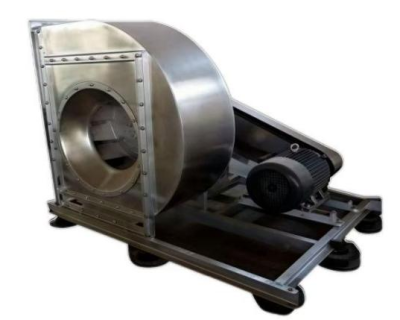
A centrifugal fan pulls air in axially (straight into the center), then discharges it radially (outward, typically turning the flow ~90°).
Step 1: Air enters at the fan inlet (the “eye”)
Air comes into the center opening of the fan. That center is often called the inlet or the eye.
Step 2: The impeller accelerates air outward
As the impeller spins, the blades drag and accelerate air from the center toward the outer edge. Air Control Industries describes this core action clearly: air moves from the center of the impeller to the outside edge and exits at an angle of about 90 degrees to the axis.
Step 3: The housing collects and directs the discharge
Once air leaves the impeller, the housing guides it toward the outlet.
Where the pressure comes from: impeller energy + the volute “diffuser” effect
Contractors usually feel static pressure as “the system fighting back.” Technically, static pressure is the pressure available to overcome resistance in the system.
Here’s the key idea:
The impeller adds energy to the air primarily as velocity (kinetic energy).
The scroll/volute shape helps slow and straighten that air, turning part of the velocity into static pressure.
What this means in selection
If your application is ducted—especially with filtration, coils, sound attenuators, or long runs—your fan selection needs to be driven by total external static pressure (TESP) as much as airflow.
The selection reality: fan curve + system curve = your operating point
This is the part many explainers skip.
A centrifugal fan has a fan curve (what the fan can do). Your duct system has a system curve (how much pressure it takes to move a given airflow through your ductwork and components).
Where those curves intersect is the operating point.
What inputs you need (before you choose the fan)
Keep this simple and repeatable:
Target airflow (CFM or m³/h)
Estimated static pressure (from duct, fittings, filters, coil, dampers, grilles)
Air condition (clean air vs dusty/greasy/moist air)
Space and orientation (inlet conditions, access, maintenance)
Noise constraints (where the fan sits and what’s downstream)
Centrifugal blower vs axial fan: a practical decision rule
You’ll see both in HVAC, but they shine in different places.
Axial fansmove large volumes with lower resistance (think: free air, short discharge, low pressure drop).
Centrifugal fansare typically the safer starting point when you must overcome higher resistance in ducted systems.
If you’re comparing technologies, here’s a simple rule of thumb:
If the system is mostly “open” and low resistance → axial may be sufficient.
If the system is ducted with meaningful pressure drop → centrifugal is usually the first category to check.
For reference, Shunda AC’s product categories can help you compare options side-by-side, including Axial Flow Fans and HVAC Blower Solutions.
Next steps (if you’re selecting a centrifugal fan)
If you’re in the middle of a takeoff or submittal review, the fastest way to avoid a mismatch is to document three numbers: target airflow, estimated static pressure, and any major system restrictions (filters/coils/long runs).
From there, you can shortlist the right category and operating point. If you want to see typical product groupings, start with Shunda AC’s Centrifugal Fan category, or jump to High pressure centrifugal blowersfor higher-resistance applications.
If you share your airflow target, estimated static pressure, and duct constraints, we can help you narrow the options and identify what to validate on the fan curve before you commit.