How to Calculate Centrifugal Fan Airflow and Static Pressure
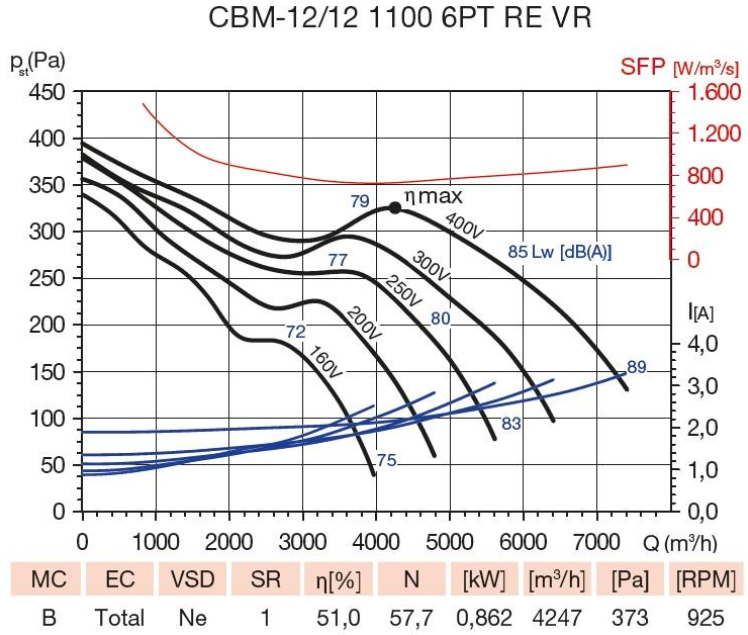
In industrial ventilation and HVAC engineering, the two most important parameters for selecting a centrifugal fan are airflow and static pressure. Many projects fail not because the fan is undersized, but because airflow is calculated without considering duct resistance, filters, coils, dampers, or elbows. A centrifugal fan must deliver the required air volume while overcoming the total system resistance, which is why airflow and static pressure should always be calculated together during system design. According to industry fan performance standards and HVAC engineering practice, the actual operating point of a fan is determined by the intersection of the fan curve and the system resistance curve, making accurate calculations essential before selecting any industrial centrifugal blower.
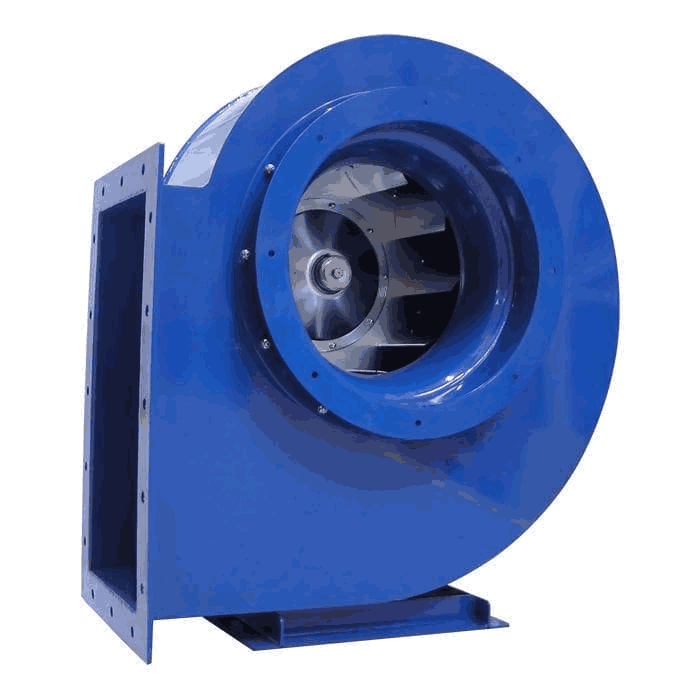
Understanding airflow and static pressure before fan selection
Airflow refers to the volume of air moved by a centrifugal fan within a specific period and is commonly expressed in m³/h or CFM. It determines how much fresh air, exhaust air, or process air your ventilation system can deliver. Static pressure, measured in Pa, represents the resistance that the fan must overcome as air travels through ductwork, filters, heat exchangers, silencers, dampers, and other ventilation components. A high-airflow fan is not necessarily suitable for a high-resistance system, which is why industrial facilities such as chemical plants, manufacturing workshops, laboratories, hospitals, and commercial HVAC systems typically rely on centrifugal fans rather than axial fans for ducted ventilation applications.
A practical way to understand the relationship is simple: airflow tells you how much air you need, while static pressure tells you how difficult it is to move that air. Both values must match the operating range shown on the manufacturer’s performance curve to ensure efficiency, stable operation, and low energy consumption.
Step 1: Calculate the required centrifugal fan airflow
The first stage of fan selection is determining the required ventilation rate. For industrial buildings, airflow is commonly calculated using the room volume and the required air changes per hour (ACH). The basic engineering formula is:

For example, imagine a manufacturing workshop measuring 30 m × 20 m × 6 m. The total room volume is 3,600 m³. If the process requires 12 air changes per hour, the required airflow becomes:

This means the centrifugal fan should be capable of delivering approximately 43,200 m³/h under the required operating pressure. This calculation method is widely used for factories, warehouses, commercial buildings, parking garages, and industrial ventilation projects because it directly reflects the ventilation demand of the occupied space.
For projects involving equipment cooling or process exhaust, airflow may instead be determined from heat load or production requirements, but the objective remains the same: establish the target air volume before calculating resistance.
Step 2: Calculate total static pressure in the duct system
After airflow is determined, the next task is calculating the total static pressure. Unlike airflow, static pressure is not measured from a single component—it is the sum of every pressure loss throughout the ventilation system. Duct friction, elbows, flexible connectors, air filters, cooling coils, dampers, louvers, and terminal diffusers all contribute to resistance. HVAC engineering guidelines recommend adding together these individual pressure losses and then including a safety margin of approximately 10–15% for reliable fan selection.
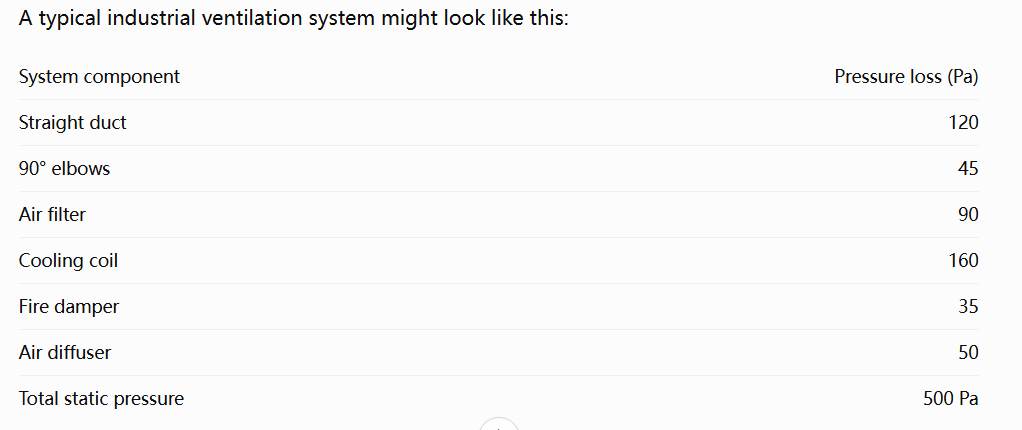
The total external static pressure is therefore 500 Pa. Instead of selecting a 500 Pa fan exactly, engineers usually choose a model rated around 550–575 Pa to compensate for installation tolerances and future filter loading. This helps maintain stable airflow over the equipment’s service life.
Velocity pressure, total pressure, and why they matter
Many engineers confuse static pressure with total pressure, but they describe different characteristics of moving air. Total pressure consists of static pressure plus velocity pressure, while velocity pressure represents the kinetic energy created by airflow speed. The relationship is expressed as:
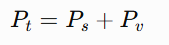
Where Pt is total pressure, Ps is static pressure, and Pv is velocity pressure. During field measurements, technicians commonly use a Pitot tube or differential pressure instrument to obtain total and static pressure, then calculate velocity pressure before determining airflow. Industry testing procedures also define fan static pressure using inlet and outlet measurements rather than simply subtracting duct pressures, ensuring consistency with manufacturer fan curves.
For duct systems, air velocity can be estimated from velocity pressure, and airflow is obtained by multiplying velocity by the duct cross-sectional area. This measurement method is commonly used during commissioning and HVAC testing & balancing.
Practical example: selecting an industrial centrifugal fan
Consider a pharmaceutical production workshop that requires continuous exhaust ventilation. The calculated airflow requirement is 18,000 m³/h, and the pressure losses are estimated as follows:
Ductwork: 150 Pa
HEPA filter: 180 Pa
Coil section: 120 Pa
Dampers and fittings: 70 Pa
The total static pressure equals 520 Pa. After adding a 10% engineering margin, the design pressure becomes approximately 570 Pa. The correct fan is therefore not the model with the highest airflow, but the centrifugal fan whose performance curve passes through 18,000 m³/h at approximately 570 Pa. This operating point provides the highest efficiency while avoiding excessive motor power and unnecessary energy consumption.

Using fan affinity laws to predict performance
One of the greatest advantages of centrifugal fans is that their performance follows the fan affinity laws. These laws allow engineers to estimate how airflow, pressure, and power change when fan speed is adjusted using a variable frequency drive (VFD). The relationships are:
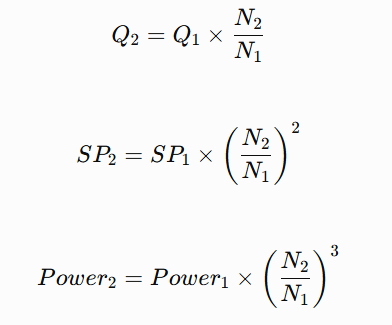
This means airflow increases proportionally with rotational speed, static pressure rises with the square of speed, and motor power rises with the cube of speed. For example, increasing fan speed by 20% raises airflow by roughly 20%, static pressure by about 44%, and power demand by nearly 73%. These relationships explain why VFD-controlled centrifugal fans can achieve substantial energy savings when operating below full speed in commercial HVAC and industrial ventilation systems.
Common mistakes when calculating airflow and static pressure
Many ventilation projects experience insufficient airflow because static pressure is underestimated during design. Long duct runs, additional elbows, dirty filters, and improperly selected dampers often increase resistance beyond the original estimate. Another common mistake is selecting a fan based solely on maximum airflow without checking the performance curve at the required pressure. In practice, the advertised maximum airflow is usually measured under free-air conditions, whereas real HVAC systems always operate against external resistance. Proper centrifugal fan selection should therefore begin with accurate airflow calculations, continue with detailed static pressure estimation, and end with verification of the operating point on the manufacturer’s fan performance curve.
Choose the right centrifugal fan for your HVAC project
Whether you are designing a commercial air handling unit, factory ventilation system, cleanroom exhaust network, or industrial process ventilation project, calculating airflow and static pressure correctly is the foundation of reliable fan selection. At Shunda HVAC, we manufacture high-efficiency centrifugal fans, FRP centrifugal blowers, backward-curved industrial fans, stainless steel centrifugal fans, and customized HVAC ventilation solutions for Southeast Asian and global industrial projects. By matching airflow, static pressure, and fan performance curves precisely, engineers can achieve higher efficiency, lower operating costs, and longer equipment life.
For customized selection, contact Shunda HVAC with your required airflow (m³/h), static pressure (Pa), duct layout, and application. Our engineering team can recommend the most suitable centrifugal fan model and provide complete technical support for your project.