What Causes Low Airflow in a Centrifugal Fan? A Complete HVAC Troubleshooting Guide
Modern industrial ventilation systems rely on centrifugal fans to deliver stable airflow and maintain healthy indoor environments. Whether installed in manufacturing plants, commercial buildings, chemical factories, warehouses, or HVAC air handling units, a centrifugal fan must overcome duct resistance while providing consistent air volume. However, many facility managers encounter a common problem: the fan motor is running, but the actual airflow is much lower than the designed value. This issue not only reduces ventilation efficiency but also increases energy consumption, creates uneven air distribution, and may shorten the lifespan of the entire HVAC system. Understanding what causes low airflow in a centrifugal fan is the first step toward improving system performance and reducing operating costs.
Unlike axial fans, centrifugal fans generate both airflow and static pressure through the rotation of an impeller inside a volute housing. The final operating airflow is determined by the balance between the fan performance curve and the resistance created by ducts, filters, coils, dampers, and other HVAC components. Even a perfectly functioning industrial blower can experience reduced airflow if the surrounding ventilation system becomes more restrictive than originally designed.
The first warning sign: airflow decreases while the motor keeps running

One of the most confusing situations in industrial HVAC maintenance occurs when the centrifugal fan appears to operate normally, yet the airflow delivered to the workspace is noticeably weaker. Operators may notice poor exhaust performance, rising workshop temperatures, insufficient fresh air supply, or increased dust accumulation despite the fan remaining powered on. In most cases, this indicates that the fan has shifted away from its designed operating point because system resistance has increased or the fan's aerodynamic efficiency has decreased. Rather than immediately replacing the motor, engineers should evaluate airflow, static pressure, duct condition, and fan speed together before identifying the true source of the problem.
Dirty impellers gradually reduce centrifugal fan efficienc
The impeller is the heart of every centrifugal fan, and its blade profile directly affects airflow performance. During long-term operation, airborne dust, grease, fibers, and industrial particles accumulate on the impeller blades, especially in woodworking factories, textile workshops, food processing plants, and manufacturing facilities. As contamination builds, the blade geometry changes and the impeller becomes less efficient at accelerating air. The motor continues rotating at normal speed, but the fan delivers noticeably less airflow while often producing additional vibration and noise. Regular cleaning of the impeller can restore airflow without replacing expensive components, making preventive maintenance one of the most cost-effective ways to improve industrial ventilation performance.
High static pressure is the biggest hidden cause of low airflow

Static pressure represents the resistance that a centrifugal fan must overcome to move air through a ventilation system. Every filter, duct elbow, cooling coil, sound attenuator, and air damper adds pressure loss. As filters become dirty or additional ductwork is installed, the system resistance increases and the operating point shifts along the fan curve, resulting in lower airflow even though the fan itself remains mechanically healthy. This explains why industrial facilities sometimes experience airflow problems immediately after upgrading to higher-efficiency filters or expanding their ventilation networks. Measuring static pressure alongside airflow provides a far more accurate diagnosis than airflow measurements alone and helps determine whether the issue originates from the fan or the duct system.
Blocked ducts and partially closed dampers restrict air movement
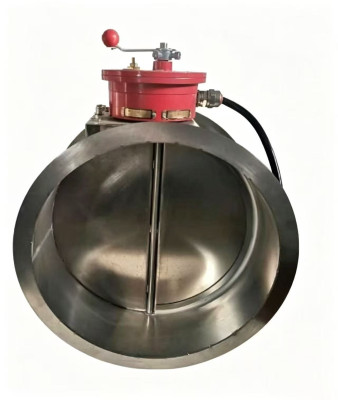
Physical restrictions inside the duct network are another frequent reason for reduced airflow. Flexible ducts may collapse under negative pressure, accumulated debris can obstruct long duct runs, balancing dampers may remain partially closed after commissioning, and fire dampers occasionally fail to return to their fully open position. These seemingly minor restrictions significantly increase airflow resistance and prevent the centrifugal blower from delivering its rated air volume to occupied spaces. Routine inspection of supply and exhaust ducts is particularly important in large industrial buildings where hidden duct sections are rarely accessed during daily maintenance.
Incorrect fan speed leads directly to lower air volume
Choosing the right centrifugal fan prevents future airflow problems
Proper fan selection is just as important as maintenance. Every industrial ventilation project should calculate the required airflow, total static pressure, duct length, operating temperature, humidity, dust concentration, and corrosion resistance before selecting a centrifugal fan. An undersized blower cannot overcome system resistance, while an oversized unit wastes energy and increases operating noise. At Shunda HVAC, we manufacture a complete range of industrial centrifugal fans, including FRP corrosion-resistant centrifugal fans, high-pressure centrifugal blowers, stainless steel centrifugal fans, and customized HVAC ventilation solutions for factories, commercial buildings, laboratories, and chemical processing facilities. Our engineering team helps customers match airflow and static pressure precisely, ensuring reliable performance and long service life.
If your ventilation system is experiencing low airflow, visit Shunda HVAC to explore our centrifugal fan solutions and request a customized quotation for your industrial HVAC project. Our engineers can help evaluate airflow requirements, static pressure, and duct design to recommend the most efficient centrifugal fan for your application.